

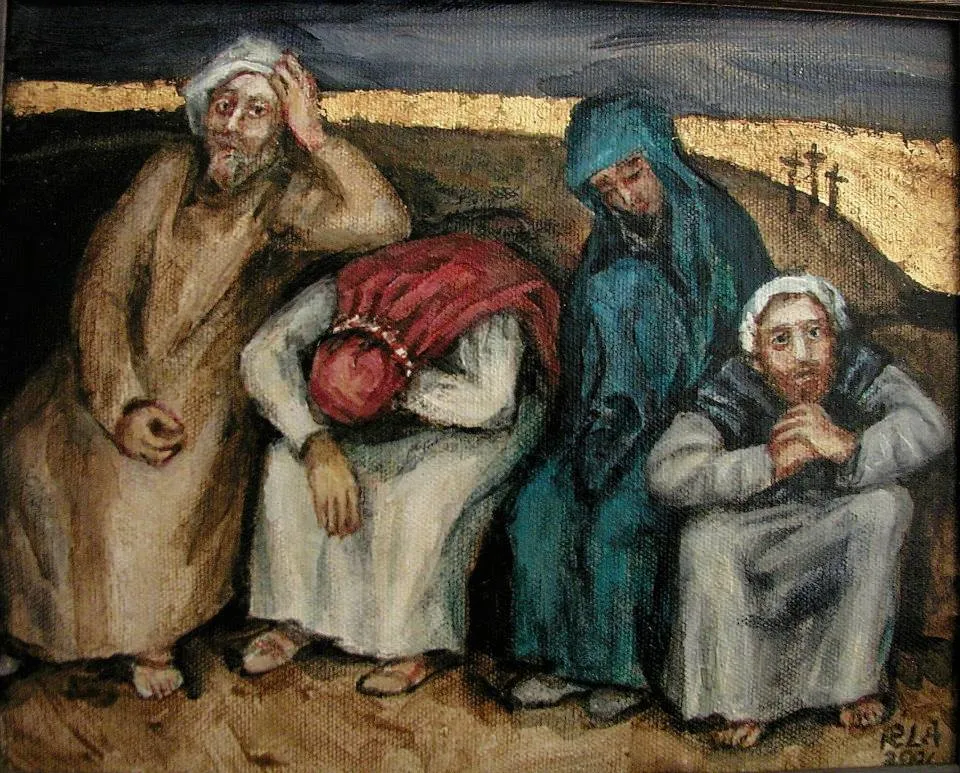
Holy Saturday Art by Roxolana Luczakowsky Armstrong
We have gathered on Thursday to remember the table. We have stood at the foot of the cross on Friday. And on Sunday, we will celebrate with everything we have.
But what about Saturday?
For the first disciples, Holy Saturday was the longest day of their lives. Jesus was dead. The tomb was sealed. Everything they had hoped for had gone silent. They didn't know an Easter was coming — they only knew the grief of right now.
We often skip this day because we don't know what to do with it. It doesn't fit our rhythm. It doesn't feel like church. But perhaps that's exactly why it matters. Holy Saturday is the day God seems quiet — and the Church has historically called us to stay there, to resist the urge to rush to Sunday morning before Saturday has done its work in us.
This year, we invite you not to skip the silence.
Whether you have 15 minutes or an entire day, below are three simple ways to inhabit Holy Saturday — alone, with your family, or with a small group. There's no right way to do this. The point is simply to be here, in the in-between, before we run to the empty tomb.
Option 1 — The Quiet Seat (15–20 minutes)
For individuals, couples, or a quiet household. This is the simplest practice. All you need is a candle, something to read, and a willingness to sit with silence.
What to do:
Light a single candle and place it where you can see it. (No other lights if possible.)
Read slowly one of these two passages — don't rush, let it land:
Psalm 88 — the only psalm with no resolution, no "but God." It ends in darkness. Let it.
Matthew 27:57–66 — the sealing of the tomb. Notice how ordinary and final it sounds.
Sit in silence for 5–10 minutes. You don't need to pray "correctly." If you have grief, bring it. If you have doubt, bring it. If you feel nothing, bring that too. Think of someone in your life who is living in their own "Holy Saturday" right now — a loss, a waiting, an unanswered prayer.
Close by praying one sentence out loud — just one. It can be as simple as: "God, I don't know what you're doing, but I'm staying."
Leave the candle burning for a while after. Let the silence linger.
Option 2 — The Family Table (45–60 minutes)
For families or small groups
This practice uses simple conversation, a shared meal or snack, and an act of remembrance together.
What to do:
Gather around a table with something simple to eat or drink — bread, soup, whatever is easy. The ordinariness is part of it.
Have someone read aloud John 20:1–2 — just Mary, alone, running from an empty tomb before she understands what it means. Or read Luke 24:13–17, the two disciples walking away from Jerusalem, talking about what they had "hoped."
Ask these questions around the table (no wrong answers):
"When have you had to wait for something, not knowing how it would turn out?"
"Is there anything in your life right now that feels like Saturday — something unresolved, something you're still hoping for?"
For children: "Has there ever been a time when you were really sad and didn't know if things would get better?"
Light a candle in the middle of the table. Explain: "We're not lighting this because we've forgotten about Easter — we haven't. We're lighting it because the disciples didn't know Sunday was coming. We're spending a little time with them in their Saturday."
Close with a prayer of lament and trust. One person can pray, or you can go around and each speak one sentence. End with "Come, Lord Jesus."
Option 3 — Three Pauses Through the Day (5–10 minutes, three times)
For individuals who want Holy Saturday woven through the whole day
Rather than setting aside a block of time, this practice invites you to stop three times — morning, afternoon, and evening — for a brief, intentional moment of remembrance.
Morning Pause (when you wake up or with your coffee) Read: Lamentations 3:1–9 — Jeremiah's raw cry of feeling trapped and forgotten by God. Ask yourself: "What am I carrying into this day that feels unresolved?" Sit quietly for two minutes. Don't fix it. Just name it.
Afternoon Pause (midday, wherever you are) Read: Psalm 22:1–2 — the psalm Jesus quoted from the cross: "My God, my God, why have you forsaken me?" Ask yourself: "Who do I know who is living in darkness right now — grief, illness, loneliness, doubt?" Pray for them by name. Briefly. Simply.
Evening Pause(before bed, after the day winds down) Read: Romans 8:38–39 — not as triumphant resolution, but as a quiet ember held in the dark. Ask yourself: "What does it mean that love stays — even here, even in this?" Light a candle or sit in the dark for a few minutes. Close by saying aloud: "It is Saturday. But Sunday is coming."
If you'd like to explore more, this Substack article by Daniel Jesse is a very helpful resource.