
Embracing the Saddest Day of the Year - Holy Saturday
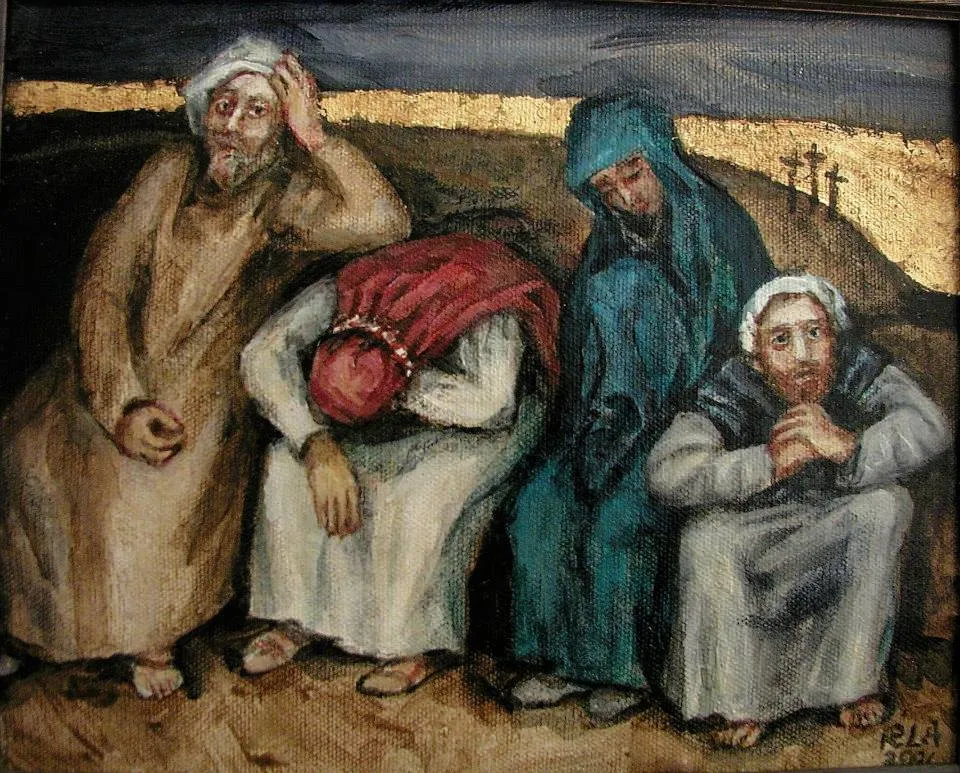
Holy Saturday Art by Roxolana Luczakowsky Armstrong
We have gathered on Thursday to remember the table. We have stood at the foot of the cross on Friday. And on Sunday, we will celebrate with everything we have.
But what about Saturday?
For the first disciples, Holy Saturday was the longest day of their lives. Jesus was dead. The tomb was sealed. Everything they had hoped for had gone silent. They didn't know an Easter was coming — they only knew the grief of right now.
We often skip this day because we don't know what to do with it. It doesn't fit our rhythm. It doesn't feel like church. But perhaps that's exactly why it matters. Holy Saturday is the day God seems quiet — and the Church has historically called us to stay there, to resist the urge to rush to Sunday morning before Saturday has done its work in us.
This year, we invite you not to skip the silence.
Whether you have 15 minutes or an entire day, below are three simple ways to inhabit Holy Saturday — alone, with your family, or with a small group. There's no right way to do this. The point is simply to be here, in the in-between, before we run to the empty tomb.
Option 1 — The Quiet Seat (15–20 minutes)
For individuals, couples, or a quiet household. This is the simplest practice. All you need is a candle, something to read, and a willingness to sit with silence.
What to do:
Light a single candle and place it where you can see it. (No other lights if possible.)
Read slowly one of these two passages — don't rush, let it land:
Psalm 88 — the only psalm with no resolution, no "but God." It ends in darkness. Let it.
Matthew 27:57–66 — the sealing of the tomb. Notice how ordinary and final it sounds.
Sit in silence for 5–10 minutes. You don't need to pray "correctly." If you have grief, bring it. If you have doubt, bring it. If you feel nothing, bring that too. Think of someone in your life who is living in their own "Holy Saturday" right now — a loss, a waiting, an unanswered prayer.
Close by praying one sentence out loud — just one. It can be as simple as: "God, I don't know what you're doing, but I'm staying."
Leave the candle burning for a while after. Let the silence linger.
Option 2 — The Family Table (45–60 minutes)
For families or small groups
This practice uses simple conversation, a shared meal or snack, and an act of remembrance together.
What to do:
Gather around a table with something simple to eat or drink — bread, soup, whatever is easy. The ordinariness is part of it.
Have someone read aloud John 20:1–2 — just Mary, alone, running from an empty tomb before she understands what it means. Or read Luke 24:13–17, the two disciples walking away from Jerusalem, talking about what they had "hoped."
Ask these questions around the table (no wrong answers):
"When have you had to wait for something, not knowing how it would turn out?"
"Is there anything in your life right now that feels like Saturday — something unresolved, something you're still hoping for?"
For children: "Has there ever been a time when you were really sad and didn't know if things would get better?"
Light a candle in the middle of the table. Explain: "We're not lighting this because we've forgotten about Easter — we haven't. We're lighting it because the disciples didn't know Sunday was coming. We're spending a little time with them in their Saturday."
Close with a prayer of lament and trust. One person can pray, or you can go around and each speak one sentence. End with "Come, Lord Jesus."
Option 3 — Three Pauses Through the Day (5–10 minutes, three times)
For individuals who want Holy Saturday woven through the whole day
Rather than setting aside a block of time, this practice invites you to stop three times — morning, afternoon, and evening — for a brief, intentional moment of remembrance.
Morning Pause (when you wake up or with your coffee) Read: Lamentations 3:1–9 — Jeremiah's raw cry of feeling trapped and forgotten by God. Ask yourself: "What am I carrying into this day that feels unresolved?" Sit quietly for two minutes. Don't fix it. Just name it.
Afternoon Pause (midday, wherever you are) Read: Psalm 22:1–2 — the psalm Jesus quoted from the cross: "My God, my God, why have you forsaken me?" Ask yourself: "Who do I know who is living in darkness right now — grief, illness, loneliness, doubt?" Pray for them by name. Briefly. Simply.
Evening Pause(before bed, after the day winds down) Read: Romans 8:38–39 — not as triumphant resolution, but as a quiet ember held in the dark. Ask yourself: "What does it mean that love stays — even here, even in this?" Light a candle or sit in the dark for a few minutes. Close by saying aloud: "It is Saturday. But Sunday is coming."
If you'd like to explore more, this Substack article by Daniel Jesse is a very helpful resource.

Elder Nominations
Dear Church Family,
We are thankful for the Lord’s continued work in our midst as we move toward becoming a particular church. A key step in this process is the nomination and election of ruling elders, men who will shepherd, teach, and lead this body according to God’s Word.
We are now opening the nomination period for elder candidates, beginning Thursday, June 5 and closing Monday, June 16.
We invite all communing members to prayerfully consider participating in this important process. As members of Christ’s body, you play a vital role in recognizing those among us who meet the biblical qualifications (see 1 Timothy 3:1–7 and Titus 1:6–9) and are called to serve as elders in Christ’s Church. After reading and prayerfully considering the qualifications of elder, you might find this article helpful for the particular aspects of the calling and character of an elder.
Nomination forms will be available online here.
Please submit completed forms by the close of day on June 16.
Let us seek the Lord together, asking for wisdom, unity, and discernment as we entrust this process to Him.
In Christ,
Pastor Chris
On behalf of the Church Plant Leadership Team

2023 Advent Devotional: Week 4
“The people who walked in darkness have seen a great light; those who dwelt in a land of deep darkness, on them has light shone.” (Isaiah 9:2)
Oh, behold, my Savior has come!
And my soul will tell of His praise
For He Who is strong has come to the weak
And, at last, He will reign as our King of Peace!
Have you ever waited for the sun to rise and warm the day?
Have you ever waited in a dark room for the light to be restored?
Have you ever waited in a quiet place for good news?
We all have waited in some way feeling forgotten or too little to be remembered. It may be exactly how the people felt before Jesus’ birth. Has God forgotten to send the Messiah? Will He actually bring all that He has promised? Feeling too little also seems to be how Mary saw herself. Yet from her “humble estate,” she remembers who God is.
Luke 1:46-49 says, “And Mary said, ‘My soul magnifies the Lord, and my spirit rejoices in God my Savior, for he has looked on the humble estate of his servant. For behold, from now on all generations will call me blessed; for he who is mighty has done great things for me, and holy is his name.’”
Mary continues in her song to proclaim the great things that the Lord has done. Scattering the proud; bringing down the mighty; exalting the humble; filling the hungry; showing his strength (Luke 1:51-53). But all of this can be summed up in that God will level and straighten all things for His glory. Mary acknowledges and proclaims that only the Lord is great enough to do this work. It is the Lord who is mighty and holy.
As we celebrate Christmas Day, we know that God did keep His promise to send the Messiah. He did fulfill all that the prophets said He would. He showed His greatness and mightiness, His mercy and kindness. Today and every day may we hold fast to who God is from even our own humble estates, and remember that “The people who walked in darkness have seen a great light; those who dwelt in a land of deep darkness, on them has light shone.” (Isaiah 9:2)
— Kimber Callen
2023 Advent Devotional: Week 3
Whatever kind of dark place you find yourself in this advent, remember the words prophesied by Zechariah about your Redeemer…
O come Thou Dayspring come and cheer
Our spirits by Thine advent here
Disperse the gloomy clouds of night
And death’s dark shadows put to flight
Rejoice, rejoice Emmanual
Shall come to thee O Israel
The days of winter bring cold and darkness, and with those cold, dark days seems to come a feeling of heaviness and loneliness. Like the creation around us, we tend to retreat in the cold and the dark. One such creature is the wood frog. Wood frogs quite literally retreat into a dark layer of leaves on the ground and then freeze during the winter. Their bodies sense the coming cold and then produce a sort of antifreeze so that everything in them can freeze and stop except for the space within their cells. Then one, warm spring day the wood frog begins to thaw and live again. But it takes trusting and knowing the light and warmth of spring will come again for the wood frog to “live” during the cold and dark winter.
Luke 1:78-79 says, “because of the tender mercy of our God, whereby the sunrise shall visit us from on high to give light to those who sit in darkness and in the shadow of death, to guide our feet into the way of peace.”
Maybe physically you feel the weight of the winter darkness. Maybe emotionally you feel the weight of loneliness and sorrow. Maybe spiritually you feel the weight of darkness and aloneness. Whatever kind of dark place you find yourself in this advent, remember the words prophesied by Zechariah about your Redeemer: “the sunrise shall visit us from on high to give light to those who sit in darkness and in the shadow of death, to guide our feet into the way of peace.”
Just like the wood frog will not wake and be silent, we also ought to rejoice that the Light has come to our darkness. Not only has He come, but He put death’s dark shadows to flight! Rejoice, rejoice!
— Kimber Callen
2023 Advent Devotional: Week 2
We need to sing to our soul: O children come! Come with your troubles. Come with your fears. Come with your bitterness. Come and experience the grace, kindness, and rest that Jesus has ready for you!
1 . Hear the cry from Bethlehem, O children come
Son of God now born to men, O children come
Bring your troubles, bring your fears, Bring the needs that draw you near,
Find the hope of all the years – O children come! O children come!
3. Where the Father's grace has walked, O children come
Where you see the hurt and lost, O children come
Show the mercy shown to you, Gifts of kindness to renew,
Love from hearts sincere and true – O children come! O children come!
2. Peace on earth goodwill to men, O children come
Righteous rule that will not end, O children come
Lay down all your bitterness, Turn from sin's toil and distress,
Find His grace and perfect rest – O children come! O children come!
The Gettys, who wrote this song, have a strong desire for their music to not only sound good but to also communicate biblical truth we need. In this song, “O children come” may seem like an odd repetitive line, but repeating it implies there’s something we ought to remember about ourselves and about our Savior.
Matthew 19:13-15 says, “Then children were brought to him that he might lay his hands on them and pray. The disciples rebuked the people, but Jesus said, ‘Let the little children come to me and do not hinder them, for to such belongs the kingdom of heaven.’ And he laid his hands on them and went away.”
We easily acknowledge that we have sin, fears, troubles, and needs, but how often do we go to Christ with these struggles? Our sinful nature wires us to turn to anyone and anything before turning to Christ for help. So we need our hearts and minds to be rewired to come to Him; we need to sing to our soul: O children come! Come with your troubles. Come with your fears. Come with your bitterness. Come and experience the grace, kindness, and rest that Jesus has ready for you!
Use this song to rewire your heart and mind to seek Christ with all that you have. Let it be a reminder to bring your sin, fears, troubles, needs, and then be met with “the hope of all the years,” and “His grace and perfect rest!” Your loving, gracious Savior says to come to Him. Bring all that you have, and be known by Him. “O children, come!”
— Kimber Callen
2023 Advent Devotional: Week 1
Much of the time we spend Christmas remembering that Jesus came to Earth. So why would we sing a song that begins with us imploring Jesus to come? This hymn so evidently captures the reality that we live in: the already and the not yet…
Come, thou long expected Jesus,
born to set thy people free;
from our fears and sins release us,
let us find our rest in thee.
Israel's strength and consolation,
hope of all the earth thou art;
dear desire of every nation,
joy of every longing heart.
Born thy people to deliver,
Born a child, and yet a King,
Born to reign in us forever,
Now thy gracious kingdom bring.
By thine own eternal Spirit
Rule in all our hearts alone;
By thine all-sufficient merit
Raise us to thy glorious throne
Much of the time we spend Christmas remembering that Jesus came to Earth. So why would we sing a song that begins with us imploring Jesus to come? This hymn so evidently captures the reality that we live in: the already and the not yet. Already, Jesus has come to Earth living as fully god and fully man. He became a part of His creation and took on sin and death. We now live enjoying the blessings of Jesus’ work. However, we still live longing for the day that Jesus returns.
While this song has a calm and gentle melody, the petition we sing in this song is far from calm. “From our fears and sins release us”; “hope of all the earth”; “now thy gracious kingdom bring”; “rule in all our hearts.” These are not mundane requests. These are passionate longings from people who know their only hope is that God will come and deliver them.
Exodus 2:23-25 says, “During those many days the king of Egypt died, and the people of Israel groaned because of their slavery and cried out for help. Their cry for rescue from slavery came up to God. And God heard their groaning, and God remembered his covenant with Abraham, with Isaac, and with Jacob. God saw the people of Israel—and God knew.”
The people of Israel clearly had a deep desire for their suffering to be relieved, and while we don’t live in the same time as the Israelites, the longings we experience are still deep. As we sing this song throughout this advent season, let us remember that our God hears us, sees us, knows us, and one day He will come to “Raise us to thy glorious throne!”
— Kimber Callen

Ain't Nothing Better
There ain’t nothing better than being in relationship with Jesus. That’s what Paul means when he wrote about the surpassing worth of personally knowing Christ. We have the high honor and privilege to walk with him and to talk with him. He is with you and me always. He is only a simple, child-like prayer away.

Men, I really enjoyed the time and conversation with those of you who were able to be there. Several of you communicated various reasons you couldn’t. You were missed and you not only have the freedom but our encouragement to take care of those things that are important.
Whether you were there or not, the video on Lesson 5 covering on Philippians 3:1-9 is a good one. You can watch it HERE. Lesson 6 will cover Philippians 3:10-21. That video lesson can be viewed HERE.
Let me give us all a couple of encouragements:
Keep inviting men. Don’t grow weary in asking. Almost every week we’ve had a new guy come. We’re not trying to sustain that pace. But there are men out there who are in great need of safe and helpful community in the Word, full of His grace.
Spend time reflecting on what we discussed in Lesson 5 through the weekend. Ill have more on that below. Sunday or Monday, you can then turn your attention to Lesson 6. Watch the video. Work through the questions IF you have the space and time. But don’t be discouraged or let not preparing as much hinder you from coming.
Try to read the letter in one sitting. It’ll only take about 15 minutes.
Pray for each other as you meditate and think on what we are studying in Philippians. Ill give the list of our first names at the very bottom.
Contemplate and think often on this truth: There ain’t nothing better than being in relationship with Jesus. That’s what Paul means when he wrote about the surpassing worth of personally knowing Christ. We have the high honor and privilege to walk with him and to talk with him. He is with you and me always. He is only a simple, child-like prayer away.
Here’s a terrific hymn that can prime the pump of your heart. The lyrics are provided just below the video. Take some time to listen, read and even sing this song some as you ask Jesus to captivate your heart with his beauty and show you His peerless worth. He is our life, our righteousness, our all.
Almighty God, we praise you that Christ's perfect righteousness can be ours, by simple faith in him. Thank you for the example of Paul, who considered everything a loss compared to the surpassing worth ot Jesus. Please help us to see that surpassing worth ourselves, to be captivated as Paul was by Christ's infinite beauty - so that we may joytully come to reflect him more and more. We ask these things in Jesus' name and for his glory. Amen.
Men meeting on Wednesdays: Bill, Brad, Chad, Chris, David, Dustin, Jeremy, Jeremy, Kevin, Mike, Pat
Men meeting for Lunch: Chandler, Chris, Jeff, Johnny, Larry
Yours in Christ and hope to see you Wednesday or soon,
Pastor Chris
865-237-1717

Re-Membering The Body
Claim: Every Christian who believes the Bible should become a member of a local church, wherever he or she lives, for however long, as quickly as possible
Does that statement rankle you or raise objections in your mind? If so, this article is written for you. But don’t worry; you’re not alone. Ambivalence toward formal church membership is increasingly common, and not without reasons…
Why Local Church Membership Matters
BY WALTER HENEGAR
“The very word membership is of Christian origin, but it has been taken over by the world and emptied of all meaning. … I am afraid that when we describe a man as ‘a member of the Church’ we usually mean nothing Pauline; we mean only that he is a unit—that he is one more specimen of some kind of things as X and Y and Z.”
–C.S. Lewis, The Weight of Glory (1949)
Claim: Every Christian who believes the Bible should become a member of a local church, wherever he or she lives, for however long, as quickly as possible
Does that statement rankle you or raise objections in your mind? If so, this article is written for you. But don’t worry; you’re not alone. Ambivalence toward formal church membership is increasingly common, and not without reasons.
On the other hand, does the same statement stir strong agreement, even indignation, in your mind? If so, this article is for you, too. Especially if you’re a pastor, elder, or other church leader — because you share the blame. Membership doesn’t mean much to laypeople because it doesn’t mean enough to those of us in leadership.
Contemporary cultural trends compound the problem. Most people are highly mobile, moving half a dozen times or more in a lifetime. Technology enables us to communicate more, yet remain increasingly anonymous. Marketing invades every corner of our lives, warning that “everyone’s selling something.” And the Church’s chronic, heartbreaking fragmentation into ever-smaller denominations makes it difficult to trust historical or theological markers.
Despite these powerful forces, far more is at stake than simple conformity to biblical standards. Both the peace and purity of the church — its internal harmony and the integrity of its external witness — depend on a robust understanding and practice of local church membership. In fact, it is impossible to obey the whole Bible without it.
Seams and Lines
The Bible uses sturdy metaphors to portray the vital connection between those who are united with Christ by faith, and therefore united with each other in His church. These pictures include: a body of uniquely gifted individuals united in a common purpose (Romans 12, 1 Corinthians 12, Ephesians 4); a spiritual house made up of living stones (1 Peter 2:4-5); and a holy nation of citizens in the kingdom of God (1 Peter 2:9-10). In a more unitary sense, the collective Church is like a bride, cherished and beautified by her Groom (Ephesians 5:25-32).
Ironically, however, these very metaphors tend to supply the most common objection to church membership: Doesn’t my relational connection to other believers matter far more than any formal commitment to a church organization? Indeed, it does. But what’s often missed is that all of these metaphors are inherently organizational, requiring two key components in order to function: seams and lines.
If body parts, stones, or citizens are joined together, some bonding agent must hold the seam between them. And in order to distinguish a body, house, or nation from other groups around them, the lines between them must be drawn. Simply put, we have to define who’s “in,” and what binds us together. Formal membership vows accomplish both, declaring to the world that we belong to Christ (1 Corinthians 6:19-20), and declaring to a particular group of fellow believers that we are “members one of another” (Romans 12:5).
Spiritual Stitches
If we highlight the body metaphor, membership vows function like stitches, binding body parts together long enough to graft the tissues together into a vital exchange of spiritual lifeblood. By contrast, the band-aids that normally connect members to each other—demographic similarity, social connection, or a nebulous sense of “being fed” —can all dissolve and dismember the body at any moment. The same effect undermines the other biblical metaphors: imagine a bungalow gummed together with Juicy Fruit, or an inland Middle Eastern nation with no map of its borders.
Yet many churches function exactly this way. As long as individuals attend fairly regularly, tithe, attend a Sunday school class or small group, or serve in some ministry of the church, they are regarded as de facto, common-law members. Such churches may also receive members formally, but in practice it is seen as an option, required only of those wishing to take leadership roles or wishing to baptize their children. The underlying message is: You’re here because of what you do for us, not because of what God has done for you. We have thus unwittingly fostered a culture of spiritual cohabitation, leading many to shack up with a local church without ever saying “I do.” As every dating couple knows, love is perilously fragile until the knot is tied.
Of course no church will hold its seams or draw its lines perfectly. Until Christ returns, some weeds will always grow among the wheat (Matthew 13:24-30). But this does not authorize us to become sloppy farmers. Most Christians who have grown up in church know all too well how easy it is to drift out of a church over time without so much as a phone call from a pastor or elder. Is it any wonder that membership means so little to them?
Priority Love
Jesus drew the widest possible definition around the word “neighbor,” calling all Christians to show love and mercy to anyone God puts in our path, including our enemies (Luke 10:25-37, Matthew 5:44). At the same time, he strongly emphasized love between believers: “By this all people will know that you are my disciples, if you have love for one another” (John 13:35). The early church at Jerusalem devoted themselves, among other things, to “the fellowship” (Acts 2:42). Paul echoed this emphasis: “So then, as we have opportunity, let us do good to everyone, especially those who are of the household of faith” (Galatians 6:10). The same refrain rings throughout the first letter of John: “Beloved, let us love one another” (1 John 4:7). In short, we can never put limits on our love, but we must give priority to our fellow believers in Christ.
Membership gives shape and direction to our love, while helping to guard us against the sin of favoritism (Luke 12:12-14, James 2:1-13). Even in a relatively healthy church, love normally travels along the tracks of natural affinity. Friendship based on affinity is not sinful; it is simply incomplete.
For example, suppose two people in your church are miserably sick. One is an older single man who is financially successful but lives alone and has few friends. The other is a young mother like you who lives down the street, takes her kids to the same play group, and who once brought you dinner when you were sick. To whom will you bring a meal? Membership stretches us to love those who are different from us, but who nevertheless share the most important feature of our identity. Contact with all the diverse gifts — and burdens — of the body both sharpens us and blesses us.
Bearing Burdens Together
The 80/20 rule is a hallmark of virtually every nonprofit or volunteer organization: 20 percent of the organization tends to do 80 percent of the work. This rule often holds true in the church as well, and its primary cause is a low view of membership. In the absence of strong commitment to one another, responsibilities are either commandeered by the aggressive or dumped onto the passive, or both. This sort of imbalanced distribution of labor ultimately leads to conflict and division. Paul commanded the Galatian Christians to “bear one another’s burdens,” but also for each person to “bear his own load” (Galatians 6:2, 5). He rebuked “busybodies” in Thessalonica for the same reason (2 Thessalonians 3:10-12), and urged generosity among believers in Corinth “that there might be fairness” (2 Corinthians 18:13-14).
Without the common commitments of membership, church leaders easily resort to manipulation, coercion, clever marketing, or guilting people into serving each other. Of course, membership can’t prevent those sin patterns, but it provides a framework for members to work out pre-existing commitments rather than unevenly distributing expectations.
Identifying Authority
This is the most decisive argument for membership in the Bible. If you believe in spiritual authority, you must practice some form of membership. Jesus repeatedly conferred spiritual authority to His disciples, including the loaded “keys to the kingdom” in Matthew 16:19. It was Paul’s consistent pattern to establish qualified elders in every church (Titus 1:5-9, 1 Timothy 3:1-7), as well as deacons (1 Timothy 3:8-13), both of which he addressed as distinct offices in Philippians 1:1. Before leaving Ephesus he charged their elders to “pay careful attention to yourselves and to all the flock, in which the Holy Spirit has made you overseers.” Likewise Peter exhorted elders to “shepherd the flock of God that is among you,” while also charging those who are younger to “be subject to the elders” (1 Peter 5:1-5).
In order to even attempt to obey these commands, we must answer two simple questions: “Who is my flock?” and “Who are my elders?” In churches with a weak view of membership, only the most winsome leaders and most committed believers can be sure of their relationship to one another. Simultaneously, wise but less-magnetic leaders lose their appropriate influence, and weak, immature, or wayward sheep who need special care are neglected.
Membership is even more indispensable for churches with presbyterian or congregational forms of government. Think about it: If the group that is best able to identify spiritual leaders is the congregation in which they serve (a treasured principle of Presbyterianism) whose “vote” will count toward selecting them? Membership, anyone? Find any remotely democratic organization without voting requirements, and you have found a pointless organization, devoid of any real substance or authority.
Redeeming Authority
Because spiritual authority is so often abused and therefore evaded, we must also clarify what it is not. When my children insist on getting their own way, I often ask them, “Who’s in charge?” If they’re feeling one-upped, they’ll moan, “You are, dad.” But I still correct them: “Actually, God is in charge – of all of us, including me. And he put me in charge of you.”
I mention this because any view of spiritual authority flows from the ultimate authority of God. As a pastor, I am not the shepherd of my sheep; I am their undershepherd. With them I follow the Good Shepherd, to whom all authority in heaven and earth has been given (Matthew 28:18). Our model is neither Caesar nor CEO, but the Son of Man, “who came not to be served, but to serve, and to give his life as a ransom for many” (Mark 10:45). Any authority exercised by a human leader is delegated, entrusted by God “for building up and not for tearing down” (2 Corinthians 13:10).
By contrast, the absence of authority does not yield freedom, but the tyranny of our own sinful desires (Romans 6:16-23, Philippians 3:18-19, Hebrews 3:13, Jude 1:16). If you are reluctant to place yourself under the spiritual authority of other human beings, consider the chilling alternative: yourself. However spiritually mature you may be, you cannot see yourself clearly enough to shepherd your own soul. Think of the last diet or devotional resolution you made to yourself in secret. How long did it last?
The practical need for spiritual authority is especially true of college students and those with highly mobile careers. The PCA’s “associate member” category was designed for this purpose: to place oneself under temporary spiritual authority while retaining home-church membership. Few churches even make their people aware of this important option.
Limiting Authority
Scripture’s view of authority is neither cynical nor naïve. Human spiritual leaders are to be imitated, obeyed, honored and remunerated, but never uncritically. Paul himself acknowledged his own remaining sin and provided an explicit procedure for confronting an elder “on the evidence of two or three witnesses” (1 Timothy 6:19-20). He also rebuked the apostle Peter when he refused to eat with Gentile believers (Galatians 2:11-14).
Practically, this means you may rightly avoid becoming a member of a church whose spiritual leaders prove heretical or ungodly, but if you are already a member of such a church, you first have a biblical mandate to seek to humbly correct them (Ephesians 4:15-16). Every human leader needs rebuke at times — I certainly do! — yet ungodly leaders often persist in error because godly believers refuse to speak up, instead “voting with their feet” by quietly leaving the church. Both errors are made easier by the absence of a strong membership commitment. Membership won’t prevent conflict, but it can help ensure that conflict is handled in a biblical, redemptive way.
Re-membering Discipline
Church discipline is a foreign term to many churchgoers today, but Jesus Himself taught it, and it is impossible to practice without functional membership. If an offending brother (or sister) refuses to repent after one-on-one rebuke, and also to confrontation by two or more others, Jesus said his or her sin must be exposed “to the church” — implying a clearly defined group of people, and perhaps referring specifically to its leaders. If still unrepentant, the person must be treated “as a Gentile and a tax collector” (Matthew 18:15-17) — i.e., no longer a member of the church. At minimum, this makes him an object of prayer and re-pursuing with the gospel.
Likewise, when the Corinthian church tolerated a man who was sleeping with his step-mother, Paul charged them unequivocally to “not associate with” and even to “purge the evil person from among you” (1 Corinthians 5:11-13). In 1 Timothy 2:19-20, he “handed over to Satan” two opponents of the gospel. These are hard words, but they’re nevertheless designed to produce repentance and restoration. In Scripture, vital membership is such a precious privilege that being severed from the body carries a painful sting. Dis-memberment begs sinners to remember God’s grace and re-member with His church.
Fit and Fitness
Granted: Finding a Bible-believing church that fits with one’s spiritual gifts, maturity, family stage, and musical tastes can be difficult — especially in smaller cities with few churches to choose from. But beyond faithfulness to the Bible, we simply don’t have the right to expect a perfect fit. In fact, the reason a church may appear lacking in some area is because you aren’t yet a part of it!
For those who are convinced and eager to practice biblical membership, one discouraging hurdle often remains: Many churches, especially in the PCA, have made the process of becoming a member unnecessarily complicated. Someone has quipped that “It shouldn’t be harder to get into a church than it is to get into heaven.” Actually, it should; God knows our hearts, instantly, whereas validating a profession of faith takes effort. But it’s still worth asking: How much harder should it be?
Churches rightly desire to disclose their theological convictions and distinctive visions, but how much of this needs to be front-loaded into the membership process? How many classes, presentations, forms, and essays are needed to verify that someone is a brother or sister in Christ?
Our Swearing God
If the idea of making a formal membership vow still strikes you as unnecessary or traditionalist, consider our supreme model: God Himself. He created us, and He reveals Himself to us in creation and in Scripture. He has continually acted in history on our behalf, climactically in the death and resurrection of His Son, Jesus. Was all this enough? Yes. But God didn’t stop there.
From the first moment after humanity’s fall into sin, God has been making covenant promises. Not only promises, but oaths. God swears! (See Genesis 12, 15, 17, Luke 22:19-20, and Hebrews 6:13-20.) And He not only gives promises and oaths, but signs as well — think rainbows, circumcision, a virgin with child, baptism, and the Lord’s Supper. God goes way out of His way to assure us that He is going to keep His promises. And He does, every time.
The Church is the Bride of Christ. He has sworn himself to her — and to us. Should we not do the same?
PCA Membership Vows
1. Do you acknowledge yourselves to be sinners in the sight of God, justly deserving His displeasure, and without hope save in [i.e., except for] His sovereign mercy?
2. Do you believe in the Lord Jesus Christ as the Son of God, and Savior of sinners, and do you receive and rest upon Him alone for salvation as He is offered in the gospel?
3. Do you now resolve and promise, in humble reliance upon the grace of the Holy Spirit, that you will endeavor to live as becomes the followers of Christ?
4. Do you promise to support the Church in its worship and work to the best of your ability?
5. Do you submit yourselves to the government and discipline of the Church, and promise to study its purity and peace?
Walter Henegar is the pastor of Atlanta Westside Presbyterian Church.

Baptism FAQ
This article was written by The Rev. Walter Henegar, pastor of AtlantaWestside.org, a partner church of Lakeway Pres.

By Walter Henegar, pastor, AtlantaWestside.org
What is the meaning of baptism?
The Christian practice of baptism was adapted from Jewish purification rituals, so it most obviously symbolizes cleansing or forgiveness of sins. However, its meaning encompasses far more than cleansing. Jesus’ own baptism (Matthew 3:13-17, Mark 1:9-11, Luke 3:21-22, John 1:32-34) was not about cleansing, but about identifying himself fully with sinful humanity. In addition, the Apostle Paul says in 1 Corinthians 10:2 that the Israelites who passed through the Red Sea were “baptized into Moses,” i.e., identified with him as sharing in the old covenant promises and obligations. In general, then, baptism is a sign that identifies those who are “set apart” among the people of God. As Rev. Hunter Bailey puts it, “Baptism is not your sign to the world that you believe; it’s God’s sign to you that you belong.”
How much water is necessary for baptism?
We don’t think it matters. The simple meaning of the Greek word baptize is to wash or simply to get wet, and there are biblical examples of doing this by sprinkling, pouring or immersing. Some Christians argue that full immersion is necessary because many baptisms in the Bible are done on riverbanks. In those cases at least partial immersion is likely, and yet the Bible never actually describes the mechanics of this action or the specific role of the baptizer. Others argue that Romans 6:3-4 pictures baptism like a death by drowning and then rising from the water. We believe that passage is actually describing baptism more like glue, so that whatever is true of Jesus (dying and rising) is true of his people, too. And of course Jesus was never drowned, but hung up on a cross and then buried down (or sideways) in a tomb.
Why do we baptize the infant children of believers?
Along with the majority of Christians in history, we believe that baptism performs the same basic function that circumcision did in the old covenant: marking who is included among the people of God. Colossians 2:11-15 makes this connection explicit. In addition, Acts 10:44-48, Acts 16:11-15 and 1 Corinthians 1:16 mention whole households being baptized. While these passages don’t explicitly mention infants in those households, Peter had said explicitly in Acts 2:39 that the promise of the Gospel is “for you and for your children.” Our 21st century American culture is highly individualistic, but ancient Jews thought instinctively in communal terms, especially within families. This same communal logic explains how everyone who believes in Christ can receive the benefits of his perfect life and sacrificial death (see Romans 5:12-21).
Does baptizing infants guarantee their salvation?
No – and it doesn’t guarantee the salvation of older children or adults, either! Only faith in Jesus can save anyone, as the thief on the cross demonstrated (Luke 23:39-42). Being baptized is an act of obedience to Jesus’ command in Matthew 28:19-20, powerfully reminding us that his purpose is not just to save individuals, but to save us into the new family of God, the Church.
Are there benefits to being baptized as an infant?
Yes! 1 Corinthians 7:14 teaches that the children of at least one believing parent are considered “holy,” or set apart, in some special way. Much like Jews born into the old covenant (see Romans 3:1-3 and 9:4-7), children raised in the family of God have the blessing of hearing God’s promises and seeing other believers following them (however imperfectly) from an early age.
How does infant baptism relate to Reformed theology?
Reformed theology emphasizes that God sovereignly chooses all who are saved, before giving us the faith to choose him back. For example, Jesus said in John 6:44, “No one can come to me unless the Father who sent me draws him.” Ephesians 1:3-5 and Romans 8:29-30 describe God’s prior initiative using the language of predestination. This doctrine can be confusing or troubling at first, but ultimately it liberates us from obsessing about whether we are baptized before or after we profess faith in Christ. In Galatians 1:15, the Apostle Paul claimed to be set apart by God as an apostle before he was born, even though he did not put his faith in Christ until sometime in his 30s!
Does infant baptism encourage people to assume they’re saved?
False security is always a danger, but it’s not what we teach or model. Children growing up in our church witness a weekly reminder that they need to profess their own faith in order to be admitted to the Lord’s Supper with other believers. At the same time, false insecurity can be just as detrimental to young faith as false security, often leading people to get re-baptized multiple times to make sure it “takes.” We want baptized children to know that they truly belong in the church, even before they profess their faith.
Why not just dedicate the infant children of believers?
Because the Bible never commands dedication alone as an act of obedience for all Christians. Parents who baptize their children at Lakeway Pres do make a vow to “dedicate” their child to God (see below), but we always apply the sign of baptism, and the members of the church also make a vow to assist them. This puts the emphasis on God’s faithfulness first, the community of faith second, and the parents last.
What happens when baptized children profess their own faith?
The whole church rejoices! This is our hope and prayer for every baptized child. We like to think of baptism as an “invisible tattoo” that becomes visible over time. To avoid pressure from parents or peers, we encourage every child to initiate whenever they are ready, whether age six or sixteen. If their parents agree, they will reach out to the church to schedule a non-threatening interview with two elders. If these elders determine that these children have an age-appropriate understanding of the Gospel and a personal commitment to Christ, we will receive them as full communing members of the church. From then on, they have the privilege of “examining their hearts” (1 Corinthians 11:28) and receiving the Lord’s Supper every week.
Does Lakeway Pres also baptize people professing faith for the first time?
Yes! – as long as they have not been baptized before. If they have already been baptized, whether as an infant or older, we would not, for two reasons: First, because salvation is not tied to the moment of baptism, we don’t think it matters when the sign of baptism was applied, even if it is years before professing faith. Second, since our denomination is only one small part of the worldwide body of Christ, we want to recognize the validity of baptism performed by other Christian denominations.
Doesn’t baptizing infants deprive them of choosing that special moment later on?
We don’t think so. When children profess their own faith and become communing members at Lakeway Pres, it’s an extremely special moment for our whole church. More important, baptism is more about the community they’re joining than their decision to join it. Plus, even though our church won’t re-baptize people, we won’t try to stop you from being re-baptized elsewhere. Our Baptist brothers and sisters are always happy to re-baptize anyone with a valid profession of faith in Christ.
What are the vows parents make when baptizing their children?
Do you acknowledge your child’s need of the cleansing blood of Jesus Christ, and the renewing grace of the Holy Spirit?
Do you claim God’s covenant promises on their behalf, and do you look in faith to the Lord Jesus Christ for their salvation, as you do for your own?
Do you now unreservedly dedicate your child to God, and promise, in humble reliance upon divine grace, that you will endeavor to set before them a godly example, that you will pray with and for them, that you will teach them the doctrines of our holy religion, and that you will strive, by all the means of God’s appointment, to bring them up in the nurture and admonition of the Lord?
This article was written by The Rev. Walter Henegar, pastor of AtlantaWestside.org, a partner church of Lakeway Pres.

More Than Friendly
And here is the crux of the matter, the church must be far more than just friendly. The church is dying with friendliness. Being friendly is not the same as being friends. And in church we are called to be friends with Jesus and friends with all whom he is calling into friendship with himself.
So how can we foster and embody friendship within our church plant. Here are some practices we can grow in by God’s grace and help.
More Than Friendly

Not long ago, I was attending some training for church planters. There were lots of sessions and many talks over several days. It was like drinking from a fire hydrant. Yet there was one moment in one session that still after all this time stands out with crystal clear clarity. The presenter was sharing how friendship was a key value for him in his own church planting work. In fact, Christian friendship was a hallmark of his life and work with other church planters, church staff, church members and even friends in the community. He couldn’t imagine doing it any other way. I deeply resonated with this. In fact, I knew that if we were called to plant a church, friendship would have to be a key value and emphasis for us.
Friendship. We know it when we experience it. It happens at the intersection where love and affection meets trust and encouragement. It is often discovered and it requires steady intentionality. Sacrifice sustains and deepens it. A dear friend is one of life’s great treasures. Without good friends we are the poorer for it.
Jesus speaks to friendship in John 15:9-15:
As the Father has loved me, so have I loved you. Now remain in my love. If you obey my commands, you will remain in my love, just as I have obeyed my Father’s commands and remain in his love. I have told you this so that my joy may be complete. My command is this: Love each other as I have loved you. Greater love has no one than this, that he lay down his life for his friends. You are my friends if you do what I command. I no longer call you servants, because a servant does not know his master’s business. Instead I have called you friends, for everything that I learned from my Father, I have made known to you.
Jesus’ tells his disciples that friendship with him is bound up in their mutual sharing, sympathy, steadfastness, and sacrifice. In fact, Jesus is the greatest friend of all time. He alone has excelled in all of these for our eternal good.
As we plant Lakeway Pres, we long for the church to be a rich community of friends bound to Jesus and one another. We want to be marked by Jesus’ own approach of making friends and welcoming others. Gospel-shaped friendships will be a non-negotiable of our shared life. The gospel of Jesus demands it and provides for it. Jesus has already done the heavy lifting of friendship. He took up his cross and laid down his life for us. The enmity and estrangement that existed between us and him, he tore down once and for all. Faith in Jesus not only gains friendship with Jesus but we also gain a whole kingdom of friends, the most unlikely of friends. In the community of Christ, we don’t get to choose our friends. They are chosen for us already!
And here is the crux of the matter, the church must be far more than just friendly. The church is dying with friendliness. Being friendly is not the same as being friends. And in church we are called to be friends with Jesus and friends with all whom he is calling into friendship with himself.
So how can we foster and embody friendship within our church plant. Here are some practices we can grow in by God’s grace and help.
Cultivate and practice curiosity. Especially with those who are new or less known to you. Good questions are key to knowing others. They will propel conversation, minimize small talk, lead to deeper places. Good questions help us discover what makes the other person happy, sad, discouraged, hopeful, angry. Good questions really are essential for Christian community and friendship. Cultivating and practicing curiosity with require us to keep growing ourselves. Too often our selfishness, our lack of love for God and for our neighbor block us from life-sharing conversations that foster and deepen friendship.
Now, I apologize for being blunt, but as you and I practice and cultivate curiosity, we will need to shut up more. We must learn to listen well, to really hear, receive and process what people say us in response to our questions. My wife, as she read this, gives a hearty Amen! And we will need to be ready to lead with vulnerability. As we ask good questions, we will want to find appropriate ways to reveal our own hearts and to share our own struggles and disappointments, our own hopes and dreams. Finally, we need to make space by slowing down. And not just outwardly. We need our interior space to drop the hum and whirl of life down to a speed so that we don’t drown out the other person with our own noise.
May Jesus’ community, here and everywhere, grow in gospel friendship. It really does begin and end with Jesus. He has loved us to the point of laying down his own life. So that we can take up his life and share it with friends who are growing together in mutual sharing, sympathy, steadfastness, and sacrifice. Let’s be far more than friendly, lets be friends in Jesus.
There really is nothing better.